L1 Native Tokens' Final 'Monetary Premium' Is Collapsing!

比推Опубліковано о 2025-12-08Востаннє оновлено о 2025-12-08

Анотація

The monetary premium on Layer 1 (L1) native tokens is rapidly fading as stablecoins increasingly dominate as the preferred medium of exchange (MoE) in on-chain economies. While L1 valuations historically incorporated a monetary premium derived from their use as a store of value (SoV) or MoE, data shows a clear shift. On Ethereum, ETH is no longer the primary MoE; stablecoins like USDC and USDT now lead in on-chain transaction volume and top Uniswap pools. A similar trend is observed on L2s like Arbitrum. On Solana, SOL remains the primary MoE due to platforms like Pumpfun and Raydium using it as a quote currency, but USDC is gaining significant traction, especially with new launchpads like MetaDAO adopting it as the default pairing asset. On BNB Chain, USDT has overtaken BNB in trading volume, which had previously been the dominant MoE. The author argues that the market has chosen stablecoins as the superior on-chain MoE. Attempts by ecosystems to enforce their native token as a quote currency add friction and costs for users with minimal price impact. Improved on-chain UX and liquidity are reducing the historical necessity of using volatile native tokens for transactions. The next wave of users will likely use stablecoins, not native tokens, for everyday exchange, further eroding this monetary premium.

Author: Silvio (@SilvioBusonero)

Original Title: The monetary premium on L1s is fading

Compiled and Edited by: BitpushNews


The valuation of L1 blockchains is a comprehensive reflection of multiple factors: including cultural narrative (Memetics), network fees, security, and the development of upper-layer applications. Among these, the most underestimated is the so-called "Monetary Premium".

The monetary premium stems from the demand of market participants to use assets as a Store of Value (SoV) or a Medium of Exchange (MoE).

  • Store of Value is directly related to the robustness (lindiness) and degree of decentralization of an asset, so it is not an easy market entry strategy.

  • In contrast, acting as a Medium of Exchange may be easier to achieve. Tokens can serve as the primary method for value exchange and measurement within the blockchain economy.
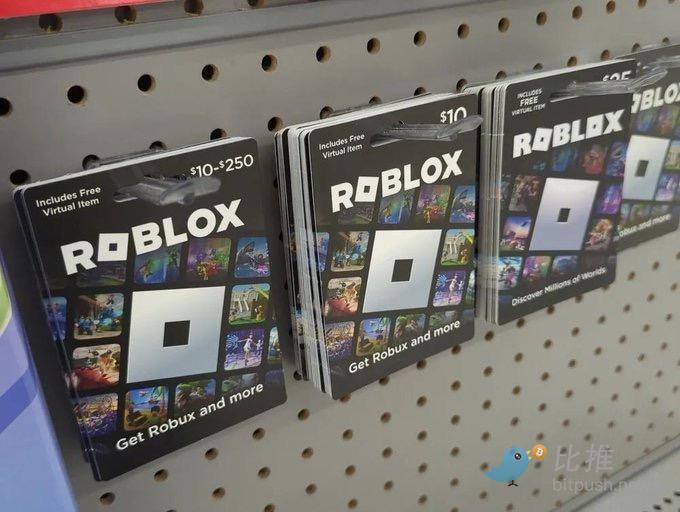
This is similar to the role of tokens in the Web2 economy:

  • Roblox's in-game token Robux, has strong exchange value.

  • When Meme coins started to grow, people bought SOL to enter and exit Meme trades. As SOL was the default currency on Pump platforms, most traders did not convert assets back to dollars but kept some SOL ready to "ape". A similar situation occurred with ETH during the 2021 NFT boom. A large number of users began using the native asset for transactions, effectively creating the utility of a Medium of Exchange (MoE).

Does the Premium Still Exist?

The answer is: No, this premium is rapidly disappearing. Users are increasingly inclined to use stablecoins for transactions.

Ethereum — Stablecoins Have Become the Medium of Exchange

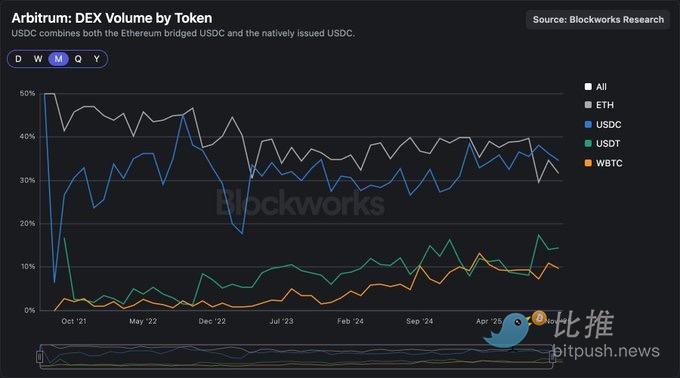
  • Judging from the on-chain transaction volume of mainstream tokens, Ethereum's native token ETH is no longer the primary medium of exchange it once was.

  • ETH's dominance as an MoE is declining, while USDC and USDT are rising in popularity on transaction volume charts and in top Uniswap liquidity pools.

The situation is similar for L2s like Arbitrum.
Solana — SOL Maintains the Lead, but USDC is Catching Up
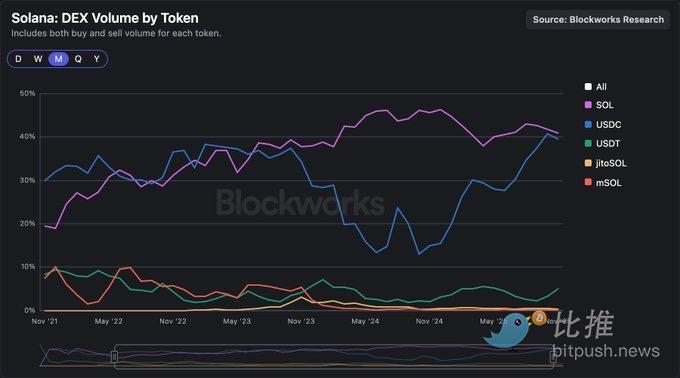
  • SOL remains the primary medium of exchange and the highest volume asset on Solana (but USDC is catching up). This is mainly because platforms like Pumpfun and Raydium tend to use SOL as the quote currency, while other platforms (like Meteora) have a mixed situation.

  • However, new launch platforms like MetaDAO are setting USDC as the default paired trading asset.

BNB and USDT Go Hand in Hand
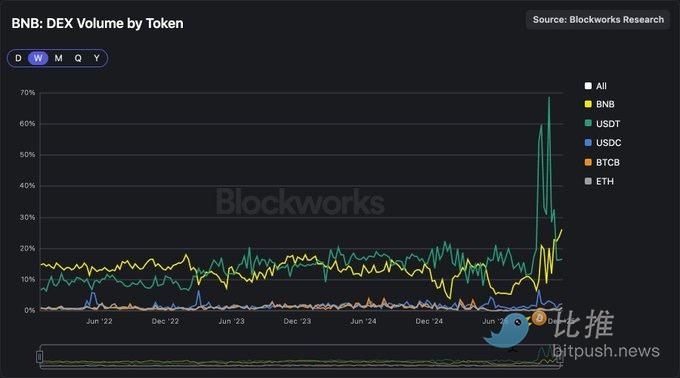
  • From 2021 to 2022, BNB absolutely dominated the role of medium of exchange, but then USDT gained market share and surpassed BNB.

The Market Has Chosen the Medium of Exchange — And It's Stablecoins

There is no such thing as "Onchain Legal Tender" in the on-chain market.

Some projects use a "quote asset" strategy, making their native token the medium of exchange, such as Zora and Virtuals. But in reality, this increases transaction costs for both users and projects, while having minimal impact on the token price itself. Ecosystem tokens can attempt a similar strategy through asset issuance platforms, i.e., requiring quotes in a specific token, but this may not be worth it.

The user experience (UX) and liquidity of the on-chain market are improving: the past monetary premium was also partly due to a lack of alternatives and lower liquidity.

The next batch of billions of users will use the same medium of exchange as in real life (USDC, Euros, etc.).


Twitter:https://twitter.com/BitpushNewsCN

Bitpush TG Discussion Group:https://t.me/BitPushCommunity

Bitpush TG Subscription: https://t.me/bitpush

Original article link:https://www.bitpush.news/articles/7594034

Пов'язані питання

QWhat is the 'monetary premium' in the context of L1 blockchains, and what two primary needs does it stem from?

AThe 'monetary premium' refers to the portion of an L1 blockchain's valuation that comes from its use as a form of money. It stems from the market's need to use the asset as a Store of Value (SoV) and as a Medium of Exchange (MoE).

QAccording to the article, which type of asset are users increasingly preferring to use for on-chain transactions instead of native L1 tokens?

AUsers are increasingly preferring to use stablecoins, such as USDC and USDT, for on-chain transactions instead of native L1 tokens like ETH or SOL.

QOn the Solana blockchain, what is a key reason why SOL remains a primary medium of exchange, and what new trend is challenging this?

ASOL remains a primary medium of exchange on Solana largely because platforms like Pumpfun and Raydium use it as the default quote currency. However, this is being challenged by new launch platforms, such as MetaDAO, which are setting USDC as the default trading pair.

QThe article states that the monetary premium is 'fading'. What two reasons are given for the past existence of this premium?

AThe past existence of the monetary premium was partly due to a lack of other options for users and lower liquidity on-chain. The improving user experience (UX) and liquidity in on-chain markets are contributing to its decline.

QWhat does the author suggest about the next billion users entering the crypto space regarding their preferred medium of exchange?

AThe author suggests that the next billion users will use the same mediums of exchange they use in real life, such as USDC or the Euro, rather than the native tokens of L1 blockchains.

Пов'язані матеріали

AI Server Power Supply Undergoes Major Transformation, ADI Bets Big with a $1.5 Billion Investment

**Title: AI Server Power Supply Undergoes Major Shift as ADI Makes $1.5 Billion Bet** **Summary:** Analog Devices Inc. (ADI) has announced a definitive agreement to acquire Empower Semiconductor in an all-cash transaction valued at approximately $1.5 billion. This move highlights the critical and growing importance of advanced power delivery technologies in the era of data-intensive AI computing. The acquisition targets Empower's key technologies that address fundamental power challenges in high-performance AI data centers: **Integrated Voltage Regulators (IVR)**, which integrate dozens of discrete components into a single IC for high density and nanosecond transient response; **ECAP Silicon Capacitors (SiCaps)**, offering ultra-low ESL/ESR for high-frequency filtering; **Vertical Power Delivery (VPD)** architecture, which reduces transmission distance and losses; and the overarching **FinFast** technology platform. ADI's strategy aims to fill the "last millimeter" gap in power delivery from the board level to directly beneath the processor die. The deal follows ADI's recent product launches and strategy focused on AI data center power, including µModule solutions, SiC switches, and 800V high-voltage DC systems. The article details the industry-wide trend towards higher integration and VPD to manage soaring GPU/accelerator power demands, now reaching kilowatt levels per card. It examines the three evolutionary stages of AI power: traditional lateral power delivery, VPD, and ultimately substrate-integrated voltage regulators (SIVR). Competitors like Infineon, MPS, Vicor, and TDK are also advancing VPD solutions, while companies like Murata, Samsung Electro-Mechanics, and Rohm are leading in silicon capacitor development. In conclusion, as AI server power consumption escalates dramatically, technologies like IVR, SiCaps, and VPD are becoming essential for efficient power delivery within constrained spaces. ADI's significant investment signals an urgent industry need for innovation in this domain.

marsbit1 год тому

AI Server Power Supply Undergoes Major Transformation, ADI Bets Big with a $1.5 Billion Investment

marsbit1 год тому

IOSG Founder: Please Tell Vitalik the Truth, May the OGs Who Enjoyed the Industry's Dividends Illuminate the Young

**Summary: An Urgent Call for Leadership and Renewal in Web3** In a candid and urgent article, the founder of IOSG Ventures voices deep concerns about the current state and future of the Web3 ecosystem, framing it as a critical turning point. The author's recent experience at a global tech conference highlighted a concerning trend: many former crypto professionals are now rebranding as founders in AI, biotech, and robotics, representing a "great self-rescue" but also a potential exodus. Key problems identified include a broken feedback loop within the ecosystem, a mass departure of developers to AI, and a severe lack of positive societal recognition for Web3, making it difficult for practitioners to take pride in their work. The author expresses worry that Ethereum, despite its foundational role, missed crucial windows for building mainstream applications by over-focusing on technical narratives like ZK and L2 during the last bull market. A significant concern is that **Vitalik Buterin might be living in an information bubble**, shielded from the community's real struggles by those with vested interests, hindering necessary reforms. The piece draws a stark contrast between U.S. and Chinese "OGs" (industry veterans). While many American OGs continue to reinvest their wealth and efforts into building the ecosystem, the author observes that a significant portion of Chinese OGs have cashed out or pivoted to other sectors like AI, leaving the Asian Web3 ecosystem with a severe funding crisis and weakened "blood-making" capacity. The central appeal is a call to action. The author urges **OGs who have benefited from the industry's growth to "light the way" for the next generation** through mentorship, grants, and direct support—not just large investments, but practical help like referrals, mailing list access, or small grants. Buterin is asked to re-engage with the grassroots, break out of his information bubble, and lead the community through this challenging bear market, which is described as the best time to build the next foundational product. For current builders and founders, the advice is to find their "why," build alliances for mutual support, continue learning (including about AI), and maintain personal well-being without letting token prices define self-worth. The author concludes that the industry's survival depends not on any single leader, but on every remaining believer becoming a "lighthouse" to guide others, ensuring the ecosystem has a future worth building for.

链捕手1 год тому

IOSG Founder: Please Tell Vitalik the Truth, May the OGs Who Enjoyed the Industry's Dividends Illuminate the Young

链捕手1 год тому

Торгівля

Спот
Ф'ючерси
活动图片